Industry Blog

Students presenting hands-on STEM and skilled trades projects at Sheridan College’s Magna School during the Ontario Skills Competition 2025.

Ontario Skills Competition 2025: Supporting Future Talent

Shaping Canada’s Future Workforce

Students participating at Sheridan College’s Magna School for the Skilled Trades during Ontario Skills Competition 2025
Magna Skilled Trades Centre | Davis Campus (Brampton)

What happens when 2,400+ students come together for the Ontario Skills Competition 2025?

You get an inspiring showcase of emerging talent, creativity, and future-ready skills. Applied Precision was proud to support this incredible event, where students, educators and industry leaders united to champion careers in Skilled Trades and STEM. Hosted by Sheridan College’s Magna School for the Skilled Trades,, in collaboration with Skills Ontario and support from Magna International.

Students presenting hands-on STEM and skilled trades projects at Sheridan College’s Magna School during the Ontario Skills Competition 2025.
Future innovators in action! Students showcase their projects at Sheridan’s Magna School for the Skilled Trades during the Ontario Skills Competition 2025.

Applied Precision’s Commitment to Talent Development

As a long-standing leader in 3D scanning, CAD modeling and dimensional inspection, Applied Precision was proud to participate in this transformative event.

Our CEO, Robert Bell, attended the event to engage with students and witness their technical creativity in action. From LEGO Robotics and Green Energy to Mechanical Engineering, Construction and Workplace Safety, the competition reflected the growing potential of Canada’s skilled workforce.


Why Events Like This Matter- Hands-On Learning at Ontario Skills 2025

This competition isn’t just about medals, it's about:

  • Career discovery in essential skilled trades

  • Building student confidence through real-world application

  • Connecting education with industry for hands-on learning

As supporters of Ontario’s colleges, universities and training programs, we believe that early exposure to advanced manufacturing technologies is critical to preparing the next generation of problem-solvers and builders.

Congratulations to All Participants of the Ontario Skills Competition 2025

A big congratulations to every student who took part in this year’s Ontario Skills Competition 2025! Your creativity, skill and dedication were on full display. To those advancing to the provincial finals this May, best of luck! You've already made us proud, and we’ll be cheering you on as you take your talents to the next level..

At Applied Precision 3D, we remain committed to fostering innovation, supporting education and advancing Canada’s skilled trades through technology and mentorship.

We’d like to thank MaryKate Grey, the team at Sheridan College, and all the partners involved for their warm hospitality and dedication to student success.

Related Reading:


Preserving a Toronto Icon!

The Significance of the Fairmont Royal York Hotel

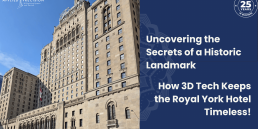
One of Toronto’s best-known landmarks, the Fairmont Royal York Hotel is the first sight when you exit Union Station. Opened in 1929, the Royal York has hosted generations of royalty, country leaders, business leaders, and those seeking a traditional luxury stay in Toronto.

Heritage preservation with 3D scanning is transforming how we conserve historical landmarks like the Royal York Hotel. At Applied Precision, we use advanced 3D scanning technologies, including LiDAR, to ensure the hotel's historical integrity is maintained while incorporating modern functionality.

A Landmark in Toronto's History

Original part of the CP HOTELS LIMITED group, the Royal York’s ‘sister’ hotels of the same generation and historic designs, all continue to sit proudly across the street from the railway stations in all of Canada’s major cities.  Arguably the most famous of these grand Canadian railway hotels, the Royal York has 28 floors and stands over 400 feet tall. For a brief time, the Royal York was the tallest building in Toronto and the British Empire!

Here’s the challenge, it takes planning, care and attention (and re-investment!) to keep a beautiful 100 year old landmark hotel in perfect condition and operating efficiently.  This is where the 3D expertise and technology of the Applied Precision 3D Team came in.  We were called upon to digitize critical parts of the Royal York’s infrastructure to support repairs, upgrades and modernization of these essential parts of the stately hotel.  This created a ‘digital twin’ of portions of the Royal York’s ‘behind the scenes’ infrastructure. This subsequently served as the digital twin design reference for planning and designing necessary repairs and upgrades for the hotel.

Preserving historic landmarks like Royal York Hotel is essential for maintaining our cultural heritage. At Applied Precision, we utilize advanced 3D laser scanning and LiDAR technologies to support the restoration and conservation of such iconic structures.

Royal-York-Hotel-3d-scanning
100 year old landmark hotel

How Heritage Preservation with 3D Scanning Helps Maintain the Royal York Hotel

Traditional methods of surveying and documenting historical structures can be invasive and may not capture intricate details accurately. Our 3D laser scanning and LiDAR technologies offer non-invasive, high-precision solutions that capture comprehensive data, facilitating informed restoration decisions.

Why 3D Scanning is Essential for Heritage Preservation

  • High Accuracy and Detail: 3D laser scanning captures millions of data points, creating detailed 3D models that accurately represent the structure's current state. This level of detail is crucial for preserving intricate architectural features.

  • Non-Invasive Data Capture: The technology allows for thorough documentation without physical contact, preserving the integrity of delicate structures.

  • Efficient Documentation: Rapid data collection accelerates the documentation process, reducing time and costs associated with manual surveys.

  • Comprehensive Analysis: The detailed models enable in-depth analysis of structural conditions, aiding in identifying areas requiring restoration.

By employing 3D laser scanning, preservationists can ensure that every aspect of a building, from grand facades to delicate interior elements, is meticulously recorded.

The Role of LiDAR in Cultural Heritage Preservation

LiDAR (Light Detection and Ranging) technology enhances our preservation efforts by providing high-resolution 3D models that serve as accurate records of historical landmarks. These models help direct and evaluate restoration projects, ensuring that the work executes accurately and aligns with the original design.

Applied Precision 3D at the Hotel
Our Team at the Hotel

Applied Precision's Contribution to the Royal York Hotel

By utilizing heritage preservation with 3D scanning, Applied Precision's team digitized critical components of the Royal York Hotel's infrastructure, creating a 'digital twin' of its essential systems. This high-precision digital replica serves as a reference for repairs and restoration, preserving the hotel's integrity while integrating modern features..

We take pride in conserving this iconic structure, ensuring the Fairmont Royal York graces Toronto's skyline for generations.

The integration of advanced technologies like 3D laser scanning and LiDAR is revolutionizing heritage preservation. At Applied Precision, we are committed to leveraging these tools to protect and maintain our architectural heritage. If you are involved in a preservation project and seek precise, efficient documentation solutions, we encourage you to contact us.​

Contact Applied Precision

Partner with us to ensure the longevity and integrity of our cherished historical landmarks.